Vectors & Thrust
Learning Objectives
- Formally define the difference between a scalar and a vector.
- Understand why rockets do not fly straight up into space.
- Analyze the components of an angled Thrust Vector into horizontal and vertical components.
What exactly is a Vector, and why is it possibly the most important mathematical concept in aerospace engineering?
1.3.1 Scalars vs Vectors
When you drive a car, you usually only care about one thing: Speed. Your speedometer reads $65\text{ MPH}$. Speed is what mathematicians call a scalar quantity. It possesses a magnitude ($65$) but absolutely no direction. It tells you how fast you are going, but it says nothing about where you will actually end up.
In aerospace engineering, scalars are utterly useless. If you shoot a rocket engine at $10,000\text{ km/h}$ straight down into the dirt, you're going to have a profoundly bad day. Instead, aerospace relies entirely on Vectors.
The Definition of a Vector
A vector is a physical quantity that inherently possesses both magnitude (how much power/speed) and direction (exactly where it is pointing in 3D space).
1.3.2 Why Rockets Pitch Over
If you watch a SpaceX Falcon 9 launch, you'll notice the rocket lifts straight off the pad, but within seconds, it deliberately begins to pitch over sideways toward the ocean. This is because getting to space is easy—staying there is profoundly difficult.
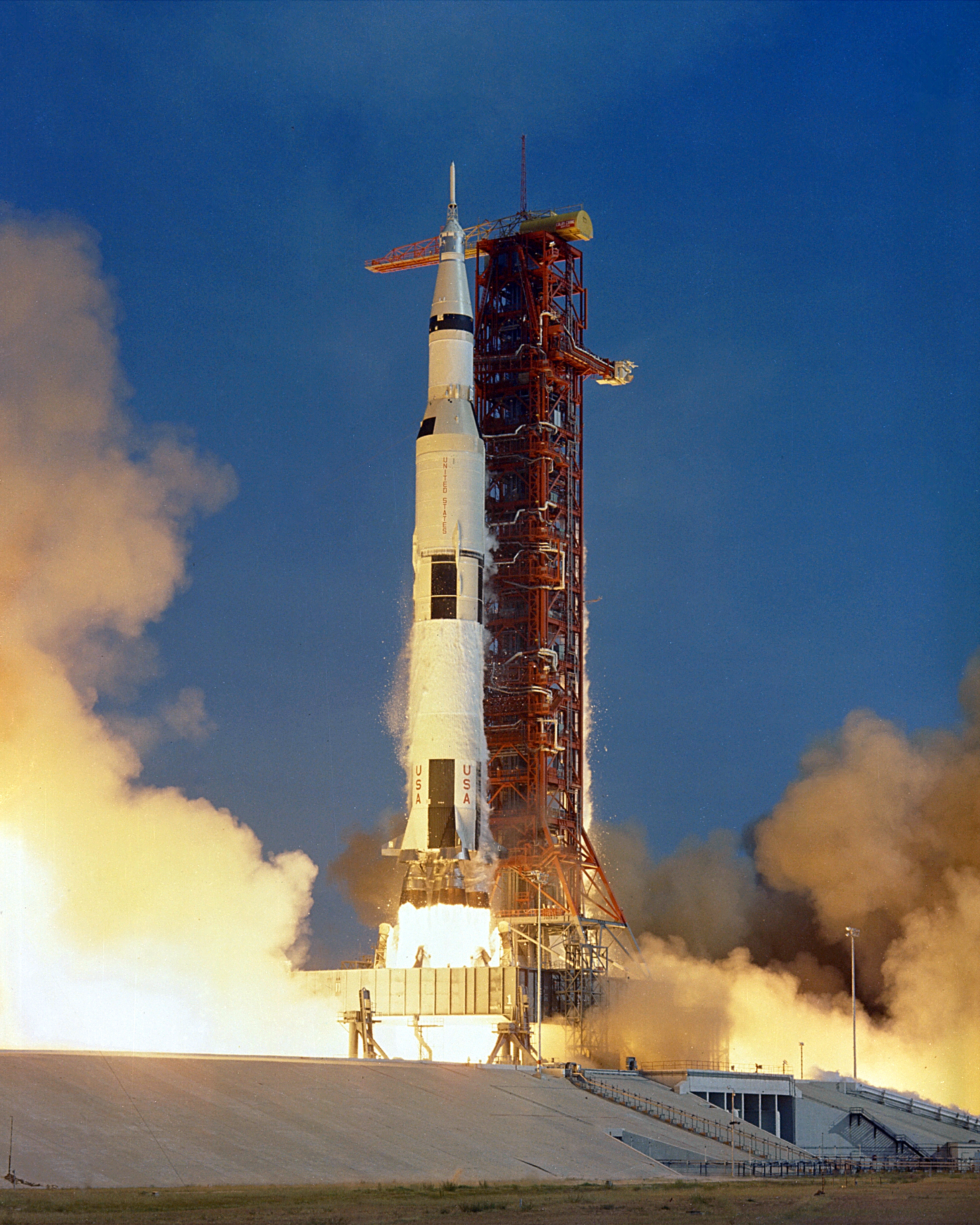
MISSION CONTEXT: APOLLO 11 LIFTOFF
The immense $34,000\text{ kN}$ thrust of the Saturn V F-1 engines was directed 100% vertically for only the first few moments of flight to clear the launch tower and punch through the densest bottom layer of the atmosphere. Almost immediately after, the rocket began pitching sideways.
To achieve a stable continuous orbit around Earth, you must be traveling sideways at roughly $7.8\text{ km/s}$ ($\sim 17,500\text{ MPH}$). If you don't aggressively build up this horizontal speed, you will simply launch $100\text{ km}$ straight up into the vacuum of space, experience a few minutes of weightlessness, and then fall straight back down onto the launch pad like a thrown baseball.
1.3.3 Vector Decomposition
Therefore, a rocket engine's Thrust Vector must be carefully angled (pitched). By pointing the engine at an angle, the massive thrust vector naturally breaks into two separate components:
- The Vertical Component (The Lifter): The mathematical part of the thrust pointing straight down at the ground. This force fights Earth's gravity to keep the rocket from falling back to the pad.
- The Horizontal Component (The Orbiter): The mathematical part of the thrust pointing sideways. This builds the massive lateral velocity needed to continuously miss the perimeter of the Earth and achieve a permanent orbit.
How do flight computers calculate exactly how much of their thrust is fighting gravity and how much is building orbital speed? We must slice the vector apart using the ancient geometry of right triangles: Trigonometry.